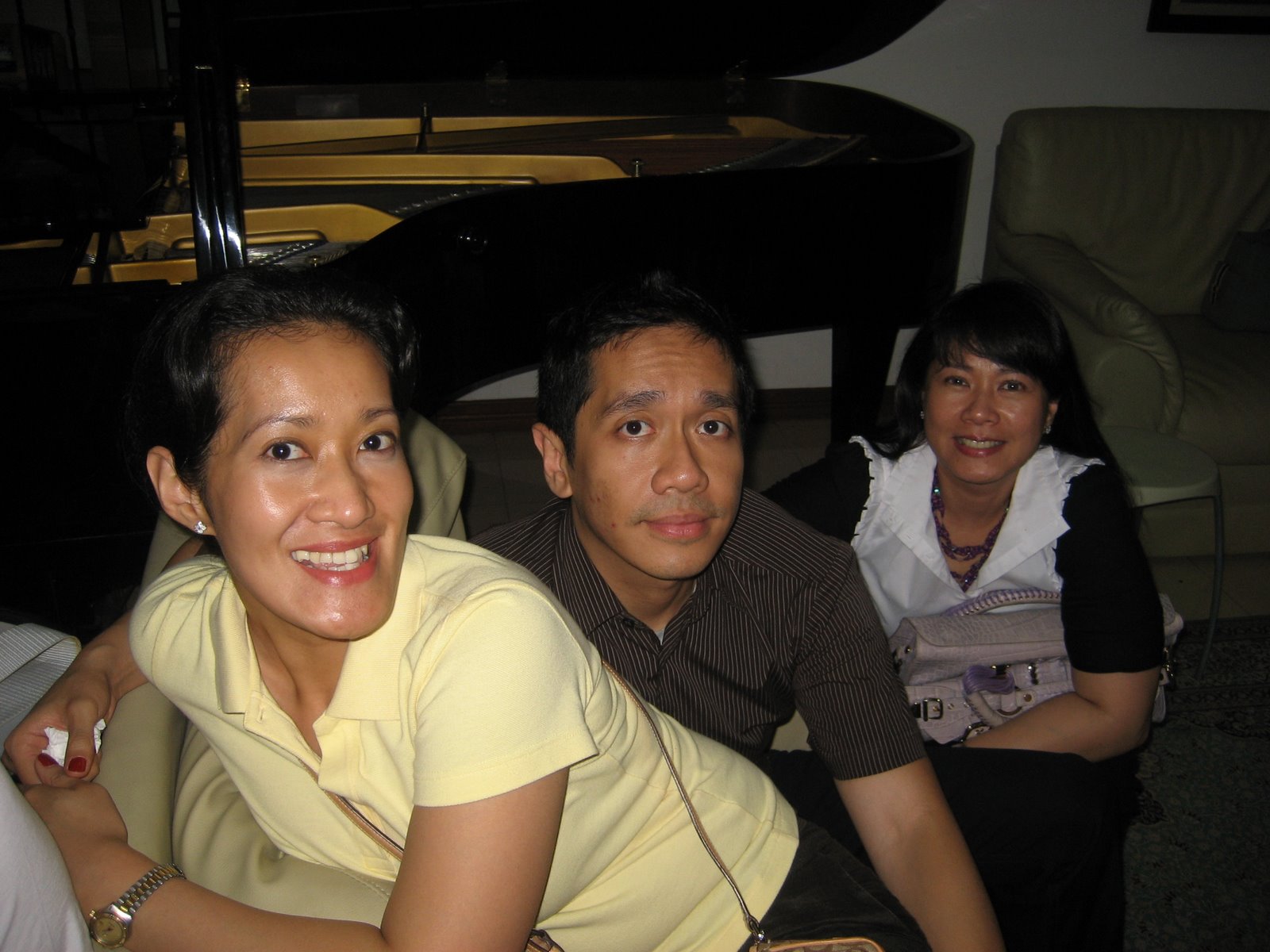
So, here I am with 7 more chemo to go.. or 8?
We (me, my sis, and my brother in law) went to 2 oncologists on the first day.
Some of you might be wondering 'what the hell is oncologist??'
Well, get the dictionary and find it! :D
First doctor was from The Gleneagles Hospital (same hospital when my dad got his chemo 3 years sgo, just different doctor) suggested the Folfox. And if I'm not mistaken, he also suggested Xelox but I can't quiet remember since my mind was on this thing the doctor said that it's going to be put/planted in to my chest and that I'd have to go under mini surgery.
Damn!
I couldn't even think straight anymore. So, whether the doctor said something about Xelox or not my mind was somewhere nowhere and all I could hear from the him was bla.. bla.. bla.. bla.. bla..
All I could think at that time was, how mini the surgery could be if he'sgoing to plant that shit into my chest?? Well, it's not like I haven't seen one. I remember my Dad had it 3 years ago when he was under chemo. But let that be his problem and incovenience hehehehehehe.. I reallly don't want to go through that so-called mini operation and have that incovenient thing inside my chest, especially with the fact that I just had a pretty big surgery a month ago and another fact that in that mini surgery they were only gave me local anaesthesia.
Hell with it!
I need drug, man!
Now, you're probably wondering what are Folfox and Xelox?
Well, they're type of chemo. See my blog forfurther info - that's if I'm (or my bro or sis..whoever) done writing.
On the same day in the afternoon, we went to National University Hospital. Went to see the doctor (again),told the same story about me (again), and the next plan (again). But with this one, they took my bloodtest.
AAAARRRRRGGGHH...!!! Mati lah gue.. matiiiii..
My inner vein is very hard to find and this means PAIN!
They poked the needle for 2 times! They found it at first, but once the needle went in .. my veins were running and the nurse lost them. Second try with 2 nurses holding and tapping my arms. Aduuuuuuuh... that needle was in already and they lost them again! That's starting to get a bit pain in the ass. Last try with 3 nurses holding me, but before they poked the needle they gave me warm Milo so that my veins can be seen asily (aaaaah.. maca' ciiiih..???).
So there you go.. me screaming like I don't know what.
Inhale exhaleinhale exhale like I was going to give birth plus answering the phone call that's been ringing for the whole 30 minutes in the lab. Short torture of taking blood test was done. We should come back to the NUH to see the oncologist and to have a CT Scan the next day.
The next day before we went back to the NUH, we went to National Cancer Center (NCC). For some reason, we already have this appointment made before we left JKT. The NCC itself .. well, okey.. lots of cancer patience. Masya Allah! Iyalaaaah.. gimana coba..?? namanya jgua National Cancer Center! Lo liat orang sakit gigi semua apa ceritanya coba..???
Kurang begitu "kena" di hati gue.
Kiri kanan kulihat saja.. banyak pasien kanker'aaaaaan (nyanyinya harus pake gaya Naik2 Ke Puncak Gunung). Yang lebih gak mengesankan lagi, waktu gue intip dokternya (associate doctor tepatnya..gak penting banget gak seeeeeeh!) CULUN, bo! Ampun culun banget!!
Gue intip dia lagi baca riwayat pasien aja tangannya sambil garuk2. Garuk2 kegatelan sama garuk2 bingung kan beda yah..? Nah, yang ini garuk2 bingung. Mampus dah gue kalo sampe dapet doi. Untung kawan juga agak lama diagnose pasien di dlm, kita punya wkt pun juga gak ada banyak alias kita harus CT Scan ke NUH. Ya sudahlah, pamitlah kita..
(blagak) reschedule buat besok aja dah..
So, kembali lah kitake NUH tapi langsung ke imaging center buat CT Scan.
Sama aja gilanya!
Tangan gue mau disuntikin cairan yang katanya biar bisa liat/highlight semua isi badan gue. DUUUUUH.. poking here and there.. Ini tangan kalo bisa tereak udah tereak dari kapan2 kali. Sama aja susahnya. Tangan kiri udah diocba, gagal! Tuker lagi pake tangan kanan. At the end of the day, tangan gue sebenernya udah biru sana sini dan memar sana sini. Tapi gak apalah, daripada dipasangin yang di dlm badan gue??
Selesai semua, ketemu sama oncologist yg di NUH (he's the chief there, btw).
Sebenernya sih pilihannya juga sama aja.
Folfox atau Xelox.
Kalo pake Folfox, ada tube yg ditanam di chest gue (ogah kan..?). I may have to have the treatment up to 12 times, each treatment lasts 2 weeks. In other words, every 2 weeks I have to go back to S'pore for a 2-day treatment.
While with Xelox is different. Xelox is a Xeloda (chemo pills) and oxaliplatin (chemo drug as well, but given by infusion for 2 hours only).
Actually, Folfox also uses oxaliplatin. But, anyway, Xelox is pretty much very convinience and more advance. I only have to stay in the hospital for 2 hours, and the rest of the chemo is in pill form that I must take for 14 days. Length of treatment is different. I have to go back to S'pore to get another infusion in 3 weeks time - next one will be June 1st. Cool, huh??
*sigh*
Well.. welcome home me! Right after the first chemo, I was in the plane back to JKT at 9 PM. Technology these days..
Suprise.. suprise..
Tuesday, May 15, 2007
My Sister's First (of 8 total) Chemo Experience


Sunday, May 6, 2007
New Picture!

Here's the latest picture of my sis after the cancer verdict. Out of the hospital, looking good, and grabing a REAL FOOD! Note also on the left her new cool cellphone. ENVY!
Friday, May 4, 2007
12 myths about colon cancer!
This article are taken from eMaxHealth.com:
12 Myths About Colon Cancer
Colon cancer is the second leading cause of cancer death in the United States, and the No. 1 cause of cancer death among non-smokers. More than 150,000 Americans will be diagnosed with colon cancer this year, and 52,000 will die from the disease.
It doesn't have to be that way.
"Most colorectal cancers are predictable by early diagnosis and screening. If colonoscopy can identify a problem early, we could completely prevent colorectal cancer," says D. Kim Turgeon, M.D., clinical associate professor of gastroenterology at the University of Michigan Medical School.
In fact, colorectal cancer screening prevents more deaths due to early detection than breast or prostate cancer screening.
Here, experts from the University of Michigan Comprehensive Cancer Center address some of the common myths and misconceptions about colorectal cancer.
Myth 1: Colon cancer is a white man's disease.
Truth: Colon cancer affects both men and women equally, and it affects people of all races. In 2007, the American Cancer Society estimates, 55,290 men and 57,050 women will be diagnosed with colon cancer. About equal numbers will die from the disease: 52,000 Americans altogether. The No. 1 risk factor for colon cancer is age
Myth 2: I don't have any symptoms, so I must not have colon cancer.
Truth: "One of the most common misconceptions is that symptoms will be evident if a person has colorectal cancer. In fact, the most common symptom is no symptoms at all," says Emina Huang, M.D., assistant professor of surgery at the U-M Medical School. More than half of people diagnosed with colon cancer have no symptoms. Symptoms such as a change in stool, rectal bleeding, abdominal pain and unexplained weight loss can all signal colon cancer. But once these symptoms begin to develop, it may be a sign of more advanced disease. Half of people diagnosed after symptoms develop will die from colon cancer.
Myth 3: Colonoscopy is difficult to prepare for.
Truth: Preparing for a colonoscopy involves cleaning the colon with the help of prescription and over-the-counter medications. Typically these are liquid drinks that must be consumed a day or two before the procedure. "People shouldn’t be afraid of it because they don't want to drink the laxative. There are many more options so you can find something that is tolerable," Turgeon says. Ask your doctor or pharmacist about your options.
Myth 4: Colonoscopy is unpleasant and uncomfortable.
Truth: It's not as bad as you think. Most people agree the prep is the worst part (see Myth 3). During the actual procedure, patients are sedated to eliminate discomfort. The procedure itself takes 15-30 minutes and you can resume normal activities the next day
Myth 5: I saw Katie Couric get a colonoscopy on the Today Show, so I should get one too.
Truth: Colonoscopy screening is recommended for men and women beginning at age 50, unless other risk factors exist. If you're 50 or older, talk to your doctor about screening. If you are younger than 50 but have other risk factors – such as family history, obesity, smoking, ulcerative colitis or Crohn's disease – talk to your doctor about your screening needs. But remember, age is the most significant risk factor for colon cancer.
Myth 6: Colonoscopy is the only way to screen for colon cancer.
Truth: There are several screening options for colorectal cancer, including flexible sigmoidoscopy, fecal occult blood test and double-contrast barium enema. But colonoscopy is considered the gold standard. It detects more cancers, examines the entire colon, and can be used for screening, diagnosis and removing polyps in one visit.
Myth 7: A polyp means I have cancer.
Truth: Polyps are benign growths that, if left unchecked, have the potential to develop into cancer. Polyps can be easily removed during colonoscopy. Not all polyps are pre-cancerous.
Myth 8: Colonoscopy is just a screening technique.
Truth: Colonoscopy is an all-in-one tool. It can find and remove polyps and small cancers all during one procedure. If your colonoscopy reveals a polyp, your doctor will remove it immediately. By removing the polyp at this stage, it prevents it from becoming cancerous. If colonoscopy reveals cancerous lesions, further treatments may be necessary.
Myth 9: If I have colon cancer, it means I am dying.
Truth: When colon cancer is caught early, it has a 95 percent survival rate. That's why screening is so important. Once colon cancer has spread to the liver, it's usually deadly, with only a 9 percent survival rate. But even then, treatments are improving. Radiation oncologists at U-M have developed a method to shrink tumors that spread to the liver, in some cases allowing them to be removed with surgery. This has led to higher survival rates even in the most advanced cases.
Myth 10: Surgery will be disfiguring and recovery painful.
Truth: New surgical advances allow for minimally invasive procedures that leave only a small scar. Patients undergoing laparoscopic surgery may have an easier recovery than patients who have open surgery. Some evidence suggests cancer control is better with a minimally invasive approach.
Myth 11: If I have colon surgery, I’ll need a colostomy bag.
Truth: A colostomy, in which surgeons create an artificial, external method to collect excrement, is rarely done anymore. Surgical techniques have improved so that the cancer can be effectively removed while sparing the rectum. In the past, cancers within 4 inches of the anus routinely required removing the anus for effective surgical control. Now, 80 percent of these cancers may be effectively removed while sparing the anus.
Myth 12: Few research advances focus on colon cancer.
Truth: Much exciting research is occurring in colon cancer. At U-M, research has focused on improving radiation techniques, including using radiation to shrink tumors that have spread to the liver. Researchers are also working with colon cancer stem cells, the small number of cells within a tumor that fuel its growth. It's believed that identifying the cancer stem cells will allow more effective drugs to be developed. Other research is looking at multiple genes involved in colon cancer and at improving screening techniques so more cancers can be detected early. This includes searching for markers in blood, stool or urine that might provide an easier screening tool to early signs of colon cancer. In the area of prevention, researchers are looking at the effects of curcumin (found in curry), resveratrol (found in red wine), ginger and the Mediterranean diet on the growth and development of colon cancer.
Thursday, May 3, 2007
Gotta Be Strong Before Chemo!
So,
The whole troops - me, my mom, my aunti, my sister and her husband, my nephew and his nanny - went to take me to see 2 doctors yesterday. The internist and the digestive surgeon. They both told me that I should start my chemo ASAP and I should keep eating during chemo. In a way, he told me to "force" myself to eat. Hey, I wonder why.. it turns out that during chemo, I'll be losing my appetite. Hmmm... Make sense. No wonder they kept telling me "eat whatever you want as long as they're clean" so that I have lots of energy for the chemo.
After the doctor announced that I'm allowed to eat whatever, we celebrate a little.
Hahahahahahahaha... For the past 3 days I'd been craving like a mad person for pizza!
So, yesterday after we left the hospital, my auntie took me for a treat at Pizza Hut!
Only me, my mom, and my auntie went dining at Pizza Hut, the rest gotta go pick up my my niece from school. But it was (kinda) fun. Imagine, I ate that pizza slooooowly. Really get the taste of the food just like I've never tasted pizza before. Hey, it's been 3 weeks I only ate that same puree food! Have mercy on me!
Anyway, I actually have a picture of me taking a delicious bite of that pizza and enjoying my new cellular phone I got from my sister. But, poor Stephanie, doesn't really know how to upload the photo - I knew actually, but it's just goddamn slow. Let that picture come up next time I have enough patience. :)
-stephanie-
Funny Clips Of The Day III
| This one is not a clip from a sitcom. Rather is a stand up comedy. Just for a quick laugh. Enjoy! |
Wednesday, May 2, 2007
What Colon Cancer Look Like
Ask Your Doctor: Colorectal Cancer ( Taken from New York Times Article May 1, 2007)
|
 Colon on an X-Ray-Red part is the Cancerous
 Sphere: Related Content
New Articles From New York Post
| Hi All, here's a new articles about Colon Cancer. A little bit scary but worth the read. By the end of the day, early detection is the sure way to beat cancer... How to Halve the Death Rate From Colon Cancer By DENISE GRADY Published: May 1, 2007 EVEN though screening tests can prevent colorectal cancer or find it early enough to cure, the disease is still the second-leading cause of cancer death in the United States, with nearly 165,000 new cases and more than 52,000 deaths expected this year. Rates of colorectal cancer have been declining in recent years, by about 2 percent annually, thanks mostly to increased screening. Yet fewer than half the people who should be screened bother to do so. If they did, the death rate could probably be halved, cancer experts say. The reason this cancer is so easily prevented or cured is that most of the time it begins as a polyp in the lining of the intestine, progressing slowly and possibly turning malignant. Tests that examine the colon can find polyps, and doctors can snip them out before they become cancers. Or the tests can reveal early tumors that can also be removed. But tests for colorectal cancer are not popular. Most adults should start being screened at age 50 (sooner for people at high risk because of family history, certain bowel disorders or gene mutations), but many put it off. Some are squeamish about the tests, which require patients to collect stool samples or have an instrument inserted into the rectum. Screening advocates point out that the unpleasantness is a small price to pay to avoid a painful and deadly disease, and most people who have had the tests say they are no big deal. The worst part of a colonoscopy, many people find, is not the test itself, which is usually done under sedation, but the “prep,” which requires a day at home to take supercharged laxatives to empty the intestines. “Data tells us this is a problem of people not feeling a strong impetus to be screened from their primary care physician,” said Dr. Robert Smith, the director of screening for the American Cancer Society. “Doctors think patients won’t want to do it, so they don’t bring it up. And they may be ambivalent about which test to endorse. Some patients get a referral, leave the office and the process of scheduling is so esoteric it just doesn’t happen. Everybody’s intending to do the right thing, but it doesn’t get around to taking place.” For people with an average risk of developing colorectal cancer, the American Cancer Society recommends that screening start at 50, with one of five tests: ¶An annual fecal occult blood test, or a new version called a fecal immunochemical test, to look for blood in the stool. ¶Every five years, flexible sigmoidoscopy, in which a scope examines the lower part of the colon. ¶An annual stool test with sigmoidoscopy every five years. ¶A test involving a barium enema and X-rays every five years. ¶Every 10 years, colonoscopy, in which a scope is inserted into the rectum to examine the entire large intestine. If one of the first four tests finds anything abnormal, colonoscopy is needed to check further. The first test developed for blood in the stool required that patients avoid eating red meat or raw vegetables for several days beforehand, to avoid false positives, but that is not required for the newer immunochemical test. This test is also easier to perform and may replace the old one, but it costs more and not all insurers cover it yet, Dr. Smith said. Patients must do the stool tests themselves at home on several samples, the cancer society emphasizes. Polyps are less likely to bleed than actual cancers, so the tests for blood are more likely to find cancers than they are to detect polyps. The drawback of sigmoidoscopy is that it examines only the lower part of the colon, so it misses polyps or cancers higher up. Barium-enema tests do not find as many small polyps as colonoscopy does, Dr. Smith said. But colonoscopy can also miss polyps, especially if doctors rush it, studies have found. Yet it is still the best test, Dr. Smith said, because when done carefully it finds small polyps, which can be removed right then. For most people, the test does not have to be done more than once every 10 years. “But is it available or can you pay?” Dr. Smith said. “Can you get the examination in a timely fashion? You may have an eight- or nine-month wait to get one.” Some doctors do tests for blood in the stool when patients are in the 10-year interval between colonoscopies, but Dr. Smith said that is “excessive and not justified.” “Virtual colonoscopy” sounds less onerous to some people. It involves using a CT scan instead of a scope, and doesn’t require sedation. It does require the same prep as colonoscopy, with a tube inserted into the rectum to inflate the colon with gas to create clearer images. Polyps cannot be removed during this procedure, so if any show up, the patient has to go back for a colonoscopy. The virtual test is being heavily marketed by some clinics, but the American Cancer Society and other groups are not recommending it yet, saying it needs more study. But Dr. Smith said, “I think the data from expert centers is really quite promising.” |